
Illustrated Specimen Details: Quattrino (Bologna)

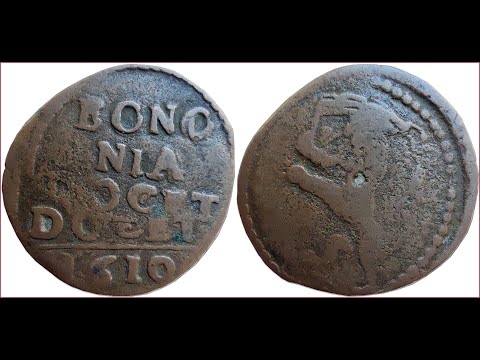
Example Specimen: 1 Quattrino, 1610 — Bologna (Papal States, Italy)
Historical Context and Authority: This coin was minted under the authority of Pope Paul V, the ruler of the Papal States from 1605 to 1621.
Design and Academic Motto: The obverse features the inscription BONONIA DOCET, which is the famous ancient motto of the University of Bologna, translating to "Bologna teaches". Bologna holds a prestigious place in academic history, as it is home to the world's oldest university in continuous operation, founded in 1088. This historic coin design remained virtually unchanged for over 150 years.
Iconography and Mint Error: The reverse depicts a rampant lion holding a banner (or flag), which is a key heraldic element from the coat of arms of Bologna. This specific specimen also exhibits a notable mint-made error known as a doubled die.
Denomination: 1 Quattrino
Date: 1610
Metal: Copper
Weight: 2.77 g | Diameter: 20 mm
Estimated value: 10$
DENOMINATION GUIDE — WHERE & WHEN (coins catalog: by names & emitents)
- ITALIAN STATES (from the 14th to the 19th century): Used extensively across various regional issuers, including the Papal States (Bologna, Fano, Ascoli, Ferrara, Foligno, Gubbio, Matelica, Ravenna), the City of Ancona, Arezzo, Bozzolo, Castiglione delle Stiviere, the Duchy of Castro, the Duchy of Ferrara, Florence, the Republic of Lucca, the Duchy of Mantua, the Duchy of Milan, the Duchy of Mirandola, the City of Pesaro, the Principality of Piombino, the Siena Republic, the State of The Presidi, the Kingdom of Etruria, the Duchy of Urbino, and the Republic of Venice. In these monetary systems, 1 quattrino = 4 denari = 1/3 soldo.
Historical Overview of the Quattrino: Small Change of Pre-Unification Italy
Etymology: The name of the quattrino coin (plural: quattrini) derives from the Italian word "quattro", meaning "four". This literally translates to "one consisting of four", indicating its initial value of 4 denari. Other notable small Italian denominations of similar standing include the trillina (valued at 3 denari) and the sesino (valued at 6 denari). Double quattrino coins were also produced and were locally known as "duetto".
The quattrino was a highly prevalent small copper or billon coin denomination used across a multitude of Italian states from the late medieval period to the late 18th century. It served as the backbone of daily retail commerce in a politically fragmented Italy.
Monetary System and Economic Role
While local monetary systems varied significantly between regions, the standard division established the quattrino as equal to 4 denari. Under this structure, multiple quattrini were grouped together to form larger transactional units, such as the soldo.
As urban economies expanded during the Renaissance and early modern periods, there was an urgent demand for low-value coinage to facilitate daily market transactions, pay modest wages, and settle small debts. The quattrino filled this economic niche perfectly. However, centuries of regional inflation and currency debasement meant that its exact silver content and purchasing power shifted constantly depending on the issuing state.
Physical Characteristics and Regional Variations
Quattrini are typically small, lightweight coins. Depending on the era and the financial health of the issuing authority, they were struck in copper, billon (a low-grade silver alloy), or occasionally base silver. Due to their low face value and massive production runs, later issues were often crudely minted and suffered from rapid wear in circulation.
The designs on these coins are exceptionally rich in local history. Issues from the Papal States frequently showcase the papal coat of arms, keys of Saint Peter, or depictions of patron saints. Meanwhile, civic issues from independent republics and duchies, such as Florence, Lucca, Venice, and Bologna, proudly displayed local heraldry, civic symbols, and abbreviated Latin legends.
Numismatic Significance
For collectors, the quattrino offers an incredibly diverse and fascinating field of study. Because dozens of different Italian states minted these coins over a span of several centuries, the sheer variety of designs, legends, and mintmarks is immense.
Attribution can sometimes be challenging due to worn surfaces and highly abbreviated Latin legends, but this difficulty only adds to their appeal. While worn examples are common, finding high-grade, well-preserved specimens of these heavily circulated everyday coins is a rewarding pursuit for any numismatist.
 ▶
▶