
Illustrated Specimen Details: Copper 4 Heller

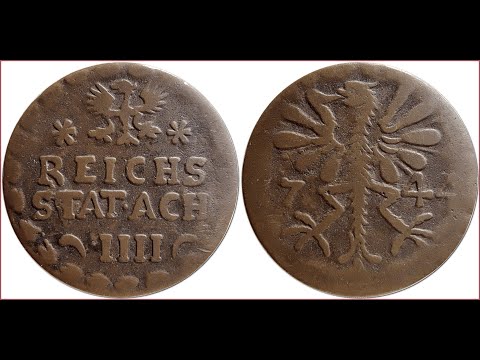
Example Specimen: 4 heller, 1744 (Aachen)
Design & Symbols: The obverse features a small eagle, the coat of arms of the Free Imperial City of Aachen, positioned between two stars. The reverse displays a larger eagle and the abbreviated inscription REICHS STAT ACH (Imperial City of Aachen) with the denomination IIII (4 heller). Notably, the Roman numeral for 4 is written in the non-standard additive format IIII instead of IV.
Denomination: 4 Heller (IIII)
Date: 1744
Metal: Copper
Weight: 1.65 g | Diameter: 19 mm
Mintage: 800.000
Estimated value: 12$
DENOMINATION GUIDE — WHERE & WHEN (coins catalog: by names & emitents)
- FREE IMPERIAL CITY OF AACHEN (1580-1798): 1 heller = 1/2 pfennig = 1/576 thaler
- GERMAN STATES (13th-19th centuries): Anhalt, Augsburg, Bavaria, Cologne, Frankfurt, Saxony, and others.
- AUSTRIA AND SALZBURG (16th-20th centuries): Subdivision of the krone (1/100).
- SWISS CANTONS (15th-18th centuries): Bern, Lucerne, Zug, and others.
- GERMAN EAST AFRICA (1904-1916): 100 heller = 1 rupie.
The name of the heller coin dates back to the early 13th century and is associated with the Häller Pfennig — silver coins first issued in the German city of Schwäbisch Hall. Over time, the term was shortened to heller and became the standard name for various small-denomination coins.
History and Etymology of the Heller
The heller was one of the most enduring and common coins in Old Europe, circulating from the 13th to the 20th centuries. While it originated as a silver pfennig in Schwäbisch Hall, it underwent continuous debasement. By the 14th-15th centuries, it had become a billon coin, and eventually a pure copper piece. This transformation reflects a broader European trend where low denominations evolved into fiduciary small change.
The Imperial City of Aachen
As a Free Imperial City within the Holy Roman Empire, Aachen maintained the right to mint its own coinage (Münzrecht). The copper heller was a staple of its local economy until the city's occupation by French revolutionary forces in the late 18th century. These coins frequently featured the imperial eagle, symbolizing Aachen's direct subordination to the Emperor.
A Central European Legacy
The use of the heller spread extensively across Central and Eastern Europe. In its early standardized form, 1 pfennig = 2 heller. In larger accounting terms, 1 groschen equaled 24 heller. The denomination persisted well into the modern era, notably in the Austro-Hungarian Empire where 100 heller equaled one crown (krone).
It is important to distinguish the German heller from its Slavic counterparts: the Czech haléř and the Slovak halier. Today, the heller remains a symbol of the incredibly complex monetary landscape of the Holy Roman Empire.
 ▶
▶