
Illustrated Specimen Details: Copper 1 Payalo

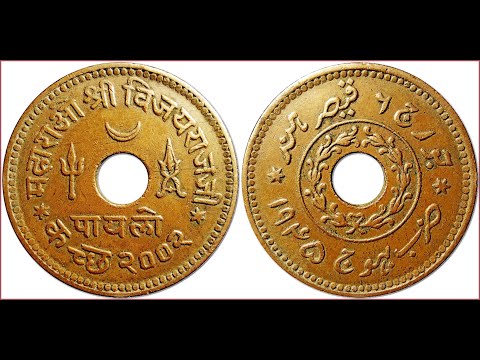
Example Specimen: 1 payalo, 1945 (Princely State of Kutch, India)
Authority & Heraldry: This distinctive holed coin was issued under Maharao Sri Vijayarajaji, the ruling Rao of Kutch (1942-1948). The obverse and reverse legends are bilingual, struck in Devanagari (महाराओ श्री विजयराजजी / Maharao Sri Vijayarajaji) and Perso-Arabic (Urdu) scripts (جورج ٦ قيصر ہند / George VI Emperor of India). The coin proudly displays traditional symbols of the Kutch State: a crescent, a trident, and a katar (a type of push dagger). It was struck in the capital city of Bhuj.
Denomination: 1 Payalo
Date: VS 2002 / 1945 AD
Metal: Copper
Weight: 8.36 g | Diameter: 27 mm
Ruler: Maharao Sri Vijayarajaji
Estimated value: 8.1$
DENOMINATION GUIDE — WHERE & WHEN (coins catalog: by names & emitents)
- PRINCELY STATE OF KUTCH, INDIA (1943-1947): 1 payalo = 12 trambiyo = 6 dokdo = 4 dhinglo = 2 dhabu = 1/2 adhio = 1/4 kori.
PAYALO as coin name: The Princely State of Kutch is renowned among global numismatists for its incredibly colorful and complex coinage system. Shortly before being absorbed into the newly formed Republic of India, the rulers of Kutch issued coins in a wide array of fractional denominations. The name payalo (written in Devanagari as पायलो) is linguistically rooted in the Sanskrit term pāda (पाद), which translates to "quarter" (reflecting its value as 1/4 kori), though it can also mean "foot". Interestingly, the word is also associated with a traditional Indian women's anklet.
History and Characteristics of the Kutch Payalo
The payalo stands out as one of the rarest denomination names in the Indian subcontinent. Only one type of Indian coin bearing this exact name is widely recognized in numismatics, and it belongs exclusively to the late coinage of the Princely State of Kutch during the 1940s.
The Central Hole Design
One of the most striking features of the 1945 payalo is the perfectly round hole in its center. This design choice was not merely aesthetic; it was an economic measure introduced during the metal shortages surrounding World War II. By striking holed coins, the Kutch mint in Bhuj conserved valuable copper while still providing everyday exchange currency for the local population.
Cultural and Political Duality
Like many coins from the Indian Princely States during the British Raj, the payalo is a masterpiece of political diplomacy. It respectfully acknowledges the British sovereign (George VI, styled as Emperor of India in Urdu) while simultaneously asserting local sovereignty through the prominent display of Maharao Vijayarajaji's name in Devanagari, alongside fierce local symbols like the trident and the katar dagger.
Key takeaway
The payalo was a unique and rare fractional copper coin equal to 1/4 kori, issued exclusively by the Princely State of Kutch in the waning years of British rule in India.
 ▶
▶