
Illustrated Specimen Details: Silver Groš

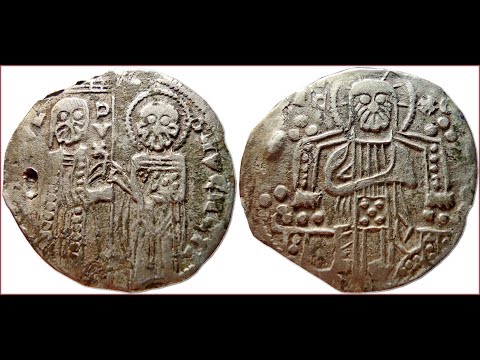
Example Specimen: Groš, 1280-1292 (Second Bulgarian Empire — imitation of Venetian coin)
Authority & Heraldry: This silver coin from the Second Bulgarian Empire was issued under George Terter I (Bulgarian "Георги Тертер I") — tsar of Bulgaria (1280-1292) from the Terter dynasty. Although categorized under the denomination groš, it is a fairly accurate, albeit almost twice lighter, imitation of the Venetian matapan grosso of Doge Giovanni Dandolo. The obverse features the Doge receiving the flag (royal banner) from Mark the Evangelist, surrounded by the legend DVX IO DΛNDVL - SM - VENETI (Latin "Dux Joannes Dandul - Sanctus Marcus - Venetiae"). The reverse depicts a typical motif of Venetian matapans: the enthroned Jesus Christ Pantocrator with the "seated Christ" motif and the legend IC - XC (an abbreviation of the Greek words for "Jesus Christ" — ΙΗϹΟΥϹ ΧΡΙϹΤΟϹ).
Ruler: George Terter I
Denomination: Groš (imitation of Venetian Grosso)
Date: ND (1280-1292)
Metal: Silver
Weight: 1.03 g | Diameter: 19 mm
Estimated value: 20$
DENOMINATION GUIDE — WHERE & WHEN (coins catalog: by names & emitents)
- SECOND BULGARIAN EMPIRE (13th-14th centuries): groš / grosh
GROŠ (grosh) as a coin name: Since the time of the Roman Empire, the denar coin (a "descendant" of the Roman denarius) was extremely widespread in most European countries. However, at the end of the 12th century, a new coin appeared on the Apennine Peninsula (modern Italy) — the denarius grossus ("large denarius"), which eventually transformed into the grosso. Similar coins began to appear in neighboring countries with adapted names — groš (Bulgaria, also grosh), groschen (Germany), groat (England), garas (Hungary), grosz (Poland), and groot (Netherlands).
History and Evolution of the Groš
Origin and Spread Across Europe
The name ultimately derives from the Latin denarius grossus, introduced as a heavier and higher-value silver denomination compared to the traditional denarius, which had gradually become smaller and lighter over time. The Italian grosso quickly became a successful monetary model and spread across Europe through trade, political influence, and imitation.
The concept of the "large denarius" evolved into a family of related coins. Despite having different regional names, these coins shared a common idea: a larger silver denomination derived from the denarius tradition.
The Bulgarian Context
In the Second Bulgarian Empire, the groš reflects the integration of Bulgaria into the broader monetary system of medieval Europe. Its use demonstrates strong economic and cultural connections with Byzantine, Latin, and Central European coinage traditions.
Key takeaway
The groš (or grosh) of the Second Bulgarian Empire was a prominent silver coin heavily influenced by the Venetian grosso. Originating from the Latin denarius grossus ("large denarius"), the denomination spread across medieval Europe, adapting to various local names while maintaining its status as a premier silver trade coin.
 ▶
▶