
Illustrated Specimen Details: State of Cambodia 20 Riels

Example Specimen: 20 Riels, 1991 — State of Cambodia
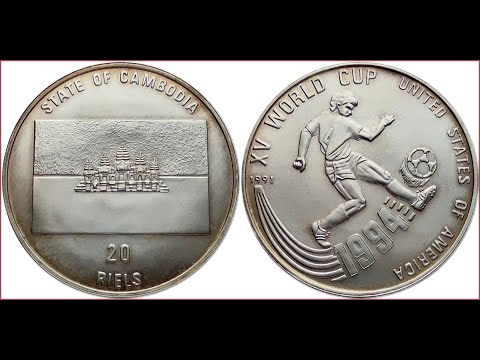
Design & Inscriptions: This striking, non-circulating silver coin is a commemorative issue dedicated to the XV FIFA World Cup hosted by the United States of America in 1994. The obverse proudly bears the inscription STATE OF CAMBODIA alongside the denomination 20 RIELS. It prominently displays the historic Cambodian national flag used from 1989 to 1993, which features the grand 12th-century temple complex of Angkor Wat at its base.
The reverse showcases a dynamic depiction of a football player kicking a ball, surrounded by the commemorative legend XV WORLD CUP — UNITED STATES OF AMERICA — 1994. Interestingly, this specimen represents a fascinating and fairly common phenomenon in international numismatics, where the formal names of two distinct sovereign states are indicated on the same coin face using equal-sized fonts.
Denomination: 20 Riels
Date: 1991
Metal: Silver (0.999)
Weight: 11.96 g | Diameter: 38 mm
Mintage: 30,000
Estimated value: 25$
DENOMINATION GUIDE — WHERE & WHEN (coins catalog: by names and emitents)
- CAMBODIA (encompassing the Khmer Republic, the People's Republic of Kampuchea, the State of Cambodia, and the modern Kingdom of Cambodia, spanning from 1970 to present): riel = 100 sen
Linguistic Origin and History of the Riel
About the name of the coin riel (Khmer "រៀល"): There are two prominent historical versions regarding the true etymology of this currency term. The generally accepted numismatic theory links the name directly to the widespread international use of Spanish silver reals across the Indochina peninsula during early global trade eras. Conversely, a popular local hypothesis suggests that the currency name derives from the Khmer word "riĕl", which translates as "small fish". These tiny fish, native to the iconic Mekong River and Tonlé Sap Lake, were historically harvested in massive quantities and served as a vital foundation for barter exchange — functioning as a practical natural substitute for money before formal minting existed.
A Resilient Currency through Political Eras
The riel has stood as the defining monetary unit of Cambodia since its initial introduction in 1953. Over the decades, its usage has faced dramatic interruptions, complete abolition under radical regimes, and subsequent successful reintroductions. The modern chronicle of the riel mirrors the turbulent political history of the nation, adapting through multiple state forms including the Khmer Republic from 1970 to 1975, the People’s Republic of Kampuchea from 1979 to 1989, the transitional State of Cambodia from 1989 to 1993, and finally the restored Kingdom of Cambodia from 1993 to the present day.
Monetary Structure and Everyday Circulation
In terms of formal division, one Cambodian riel is equal to 100 sen, which act as the smaller fractional subunits. However, due to long-term cumulative inflation, sen coins have completely lost their practical purchasing power and are no longer found in active circulation today. While the early currency issues from the 1950s to the 1970s featured a healthy mix of circulating coins in both sen and riel values, the post-1990s domestic economy saw coins become exceptionally scarce, with paper banknotes becoming the absolute standard for physical cash transactions.
The Modern Dual-Currency Environment
In the contemporary financial landscape, Cambodia remains globally unique for its deeply integrated dual-currency system. While the riel is the official sovereign currency, the United States dollar operates in complete parallel and is widely favored for larger business transactions, commercial pricing, and high-value payments. The domestic riel is most frequently utilized for minor daily transactions or as fractional change for dollar bills.
For numismatists, classic Cambodian coins from the mid-twentieth century — particularly the older sen issues — represent highly desirable collector items that carry significant historical and material value compared to modern circulating denominations.
 ▶
▶