
Illustrated Specimen Details: 2 Dinara (German Occupation)

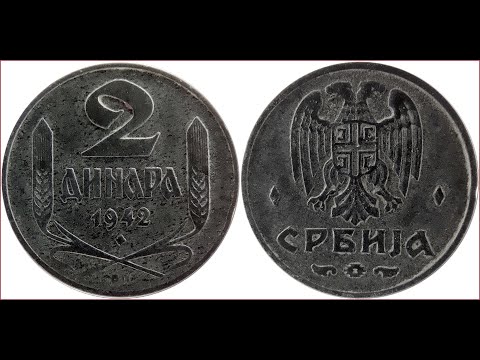
Example Specimen: 2 Dinara, 1942 — Serbia (German Occupation)
Design & Historical Context: The obverse of this World War II era zinc coin features the traditional coat of arms of Serbia, adopted for the Government of National Salvation. It displays the double-headed Serbian eagle originating from the Nemanjić dynasty and the Serbian cross with firesteels on a shield. The Cyrillic legend proudly states СРБИJА (Serbia).
The reverse highlights the denomination 2 ДИНАРА and the year 1942, flanked by two ears of wheat, symbolizing agriculture. Below the denomination is the mint mark БП, indicating that the coin was struck at the Budapest mint in Hungary. This specific wartime issue was produced with a significant mintage of 40,000,000 pieces.
Denomination: 2 Dinara
Date: 1942
Metal: Zinc
Weight: 3.6 g | Diameter: 22 mm
Mint: Budapest (БП)
Estimated value: 3.5$
DENOMINATION GUIDE — WHERE & WHEN (coins catalog: by names & emitents)
- SERBIA (from 1875 to present): Encompassing the Principality, Kingdom, German Occupation, and modern Republic. 1 dinar = 100 para.
- YUGOSLAVIA (1925-2002): Used across the State of Slovenes, Croats and Serbs, Kingdom, and Socialist Federal Republic. 1 dinar = 100 para.
- BOSNIA AND HERZEGOVINA (from the 14th century to 1997): Including medieval kingdom coinage and non-circulating issues of the modern Republic.
- ARAB WORLD: Modern and historic circulation in Algeria, Bahrain, Iran, Iraq, Jordan, Kuwait, Libya, Sudan, Tunisia, and Yemen.
Historical Overview of the Dinar
Etymology: The name of the dinar coin represents an extraordinary linguistic continuity. It ultimately derives from the ancient Roman silver coin, the denarius, which dominated the Mediterranean world two thousand years ago. Through the Late Roman and Byzantine traditions, the name was adapted into the early Islamic monetary system.
Islamic Origins and Global Expansion
The direct historical predecessor of modern dinars was the legendary gold dinar of the early Islamic world, first issued in the late 7th century under the Umayyad Caliphate. Modeled initially on Byzantine gold coinage, these coins eventually shed human imagery in favor of elegant calligraphy and religious inscriptions. Over centuries, the dinar became the dominant monetary standard across the Middle East, North Africa, and parts of Central Asia.
The Dinar in the Balkans
In Europe, the dinar found a permanent home in the Balkans. It was reintroduced to Serbia in the 19th century during the modernization of the state. Despite numerous political transitions, devastating wars, and hyperinflation crises during the Yugoslav era in the 20th century, the dinar remained the core national currency. Coins from periods like the World War II German occupation, such as the zinc 2 dinara of 1942, are poignant numismatic reminders of the region's turbulent history.
Modern Numismatic Significance
Today, the dinar is one of the most widely used currency names in the world, primarily concentrated in Arab states. Historically, it has taken the form of pure gold masterpieces, medieval silver fractions, and modern base-metal decimal coins.
For collectors, the dinar offers an unparalleled scope. A complete thematic collection can span from ancient Roman roots and classical Islamic gold to the diverse and complex 20th-century coinage of the fractured Yugoslav states. It stands as a profound symbol of economic endurance and cross-cultural adoption.
 ▶
▶