
Illustrated Specimen Details: Boliviano (Bolivia)

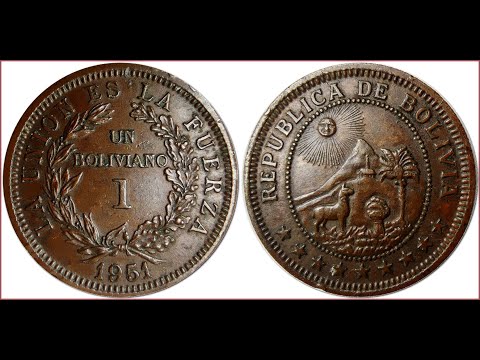
Example Specimen: 1 Boliviano, 1951 — Republic of Bolivia
Design & Inscriptions: The obverse of this bronze coin features the national motto "LA UNION ES LA FUERZA" (Unity makes strength), alongside the denomination and the date 1951. The reverse bears the title REPUBLICA DE BOLIVIA and depicts the national coat of arms as it appeared until 1963.
Heraldry: The central design includes a rising sun behind the Cerro Rico of Potosí, an alpaca (the national animal), and symbols of agriculture — a sheaf of wheat and a breadfruit. The nine stars represent the nine provinces of Bolivia, including La Paz, Potosí, and Santa Cruz.
Denomination: 1 Boliviano
Date: 1951
Metal: Bronze
Weight: 3.0 g | Diameter: 18 mm
Mint: Heaton mint (Birmingham, Great Britain)
Estimated value: 1.8$
DENOMINATION GUIDE — WHERE & WHEN (coins catalog: by names & emitents)
- REPUBLIC OF BOLIVIA (from 1864 to 1951 and from 1987 to present): 1 boliviano = 100 centavo (prior to 1870 — 100 centésimo).
Historical Overview of the Boliviano: Honors and Stability
Etymology: The Bolivian coin is named the "boliviano" in honor of Simón Bolívar, the prominent military and political leader who led the struggle for South American independence from Spain in the 19th century. This naming tradition is shared with the Venezuelan bolivar.
The boliviano serves as the fundamental monetary unit of Bolivia across two distinct historical periods. Throughout its existence, it has been consistently structured as a decimal currency.
Historical Eras and Evolution
The First Boliviano (from 1864 to 1951): This currency was introduced to replace colonial-era systems and was initially based on a silver standard. It maintained a one hundredth subdivision (first as centésimos and later as centavos). Following a period of monetary instability and inflation, it was replaced by the peso boliviano in 1952.
The Modern Boliviano (from 1987 to present): After experiencing hyperinflation, Bolivia introduced the modern boliviano. The exchange rate was set at one boliviano for every 1,000,000 pesos bolivianos. This new currency retained the traditional decimal structure where 1 boliviano equals 100 centavos.
Design and Minting
Bolivian coinage typically features national heraldry and historical figures. Specimens from the mid 20th century, such as the 1951 issue, were often produced at international facilities like the Heaton mint in Birmingham. These 1951 coins exist in three varieties: without a mintmark, with an "H" mark, or with a "KN" mark.
Numismatic Value
For collectors, the boliviano offers a diverse range of specimens. Silver issues from the 19th century are particularly highly valued, while early republican coins provide significant historical depth. Although modern coins are more common, they remain essential for completing a comprehensive series of South American currency.
 ▶
▶